Liturgical Language as a Course for Theological Thought: The Case of Dom Prosper Guéranger and the Vatican II Council

by Oliver G. Dy, S.J.

0.00

Available

login to download this publication
BACK TO:  SERIALS   |   BOOKS   |   SHOP |   CONFERENCES

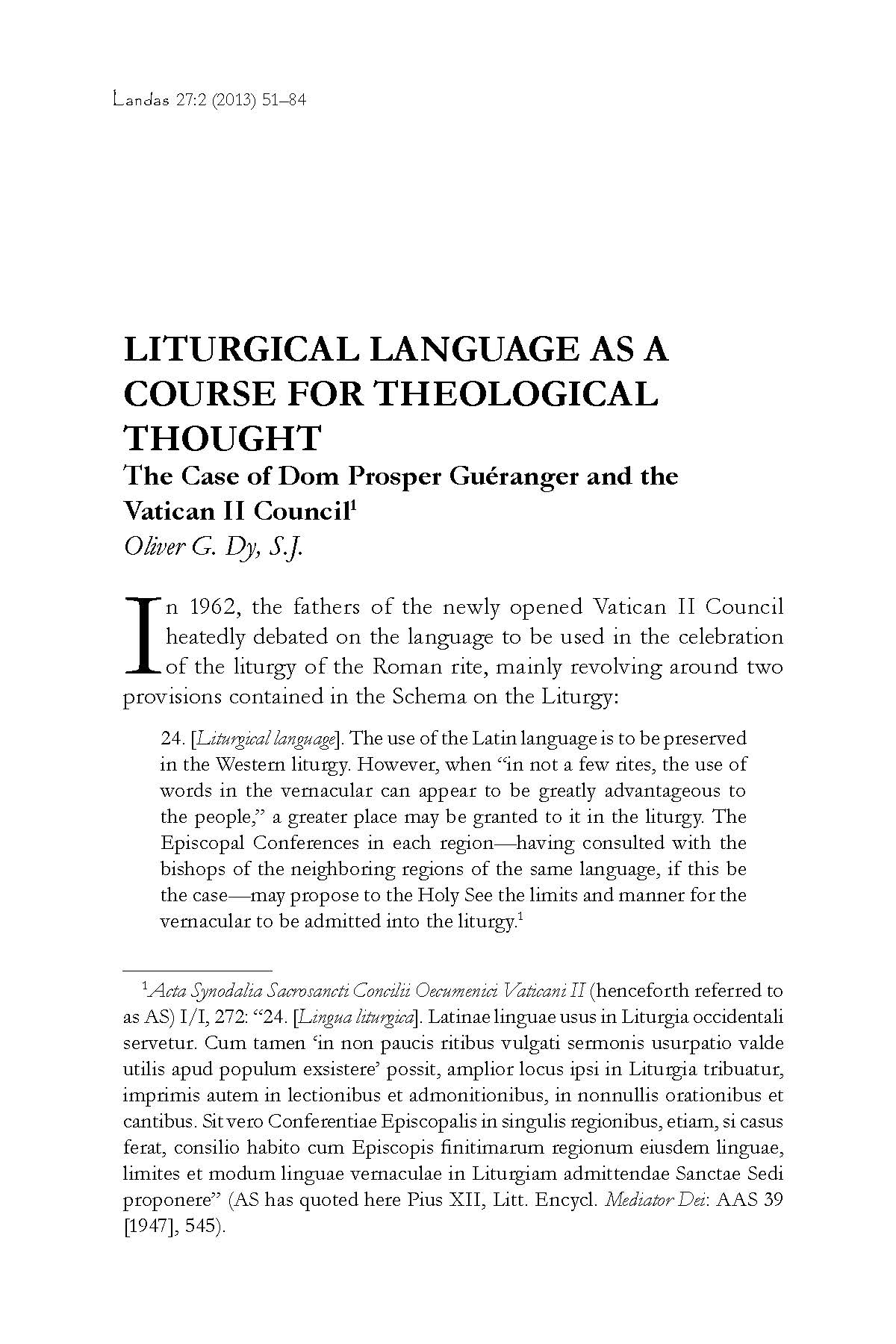
The FABC’s call for dialogue with various cultures of Asia has also given impetus to the use of the vernacular in the liturgy of the local churches. Oliver Dy revisits the debate in the Second Vatican Council and argues that the council’s decision in Sacrosanctum Concilium—to allow a wider use of the vernacular in the Roman rites—constitutes a shift away from the position of Dom Prosper Guéranger (1805–1875), whose theology contributed to the “essentialization” of Latin as the language proper to the celebration of the Mass. Dy attributes this shift to the change in the historical contexts in which Guéranger and the Vatican II Council (1962–1965) operated:

“Whereas Guéranger conducted himself under an existing climate of anti-Protestantism … Vatican II, on the other hand, had already adopted a more reconciliatory and open-minded approach towards Protestants, thanks largely to the pre-conciliar ecumenical movement received by the Council. Furthermore, Guéranger’s operative horizon was spatially confined to Europe in general and his native France in particular …. By contrast, Vatican II had a more enlarged geographical purview that embraced and highly valued the Mission territories outside Europe, some of which at the time of the Council were politically characterized by the emergent movements and strong sentiments of anti-colonialism and indigenous nationalism.” – from the Editor’s Preface

Liturgical Language as a Course for Theological Thought: The Case of Dom Prosper Guéranger and the Vatican II Council

SKU LANDAS-687 Category

The FABC’s call for dialogue with various cultures of Asia has also given impetus to the use of the vernacular in the liturgy of the local churches. Oliver Dy revisits the debate in the Second Vatican Council and argues that the council’s decision in Sacrosanctum Concilium—to allow a wider use of the vernacular in the Roman rites—constitutes a shift away from the position of Dom Prosper Guéranger (1805–1875), whose theology contributed to the “essentialization” of Latin as the language proper to the celebration of the Mass. Dy attributes this shift to the change in the historical contexts in which Guéranger and the Vatican II Council (1962–1965) operated:

“Whereas Guéranger conducted himself under an existing climate of anti-Protestantism … Vatican II, on the other hand, had already adopted a more reconciliatory and open-minded approach towards Protestants, thanks largely to the pre-conciliar ecumenical movement received by the Council. Furthermore, Guéranger’s operative horizon was spatially confined to Europe in general and his native France in particular …. By contrast, Vatican II had a more enlarged geographical purview that embraced and highly valued the Mission territories outside Europe, some of which at the time of the Council were politically characterized by the emergent movements and strong sentiments of anti-colonialism and indigenous nationalism.” – from the Editor’s Preface

AuthorOliver G. Dy, S.J.
Volume No.27
Serial No.2
Start Page51
End Page84
Publication SeriesLANDAS
FormatEbook
0

Publication Cart

Quantity: 0 Items: 0
The Cart is Empty
No Product in the Cart!
0.00
0.00
₱0.00

We serve cookies on this site to analyze traffic, remember your preference, and optimize your experience.