
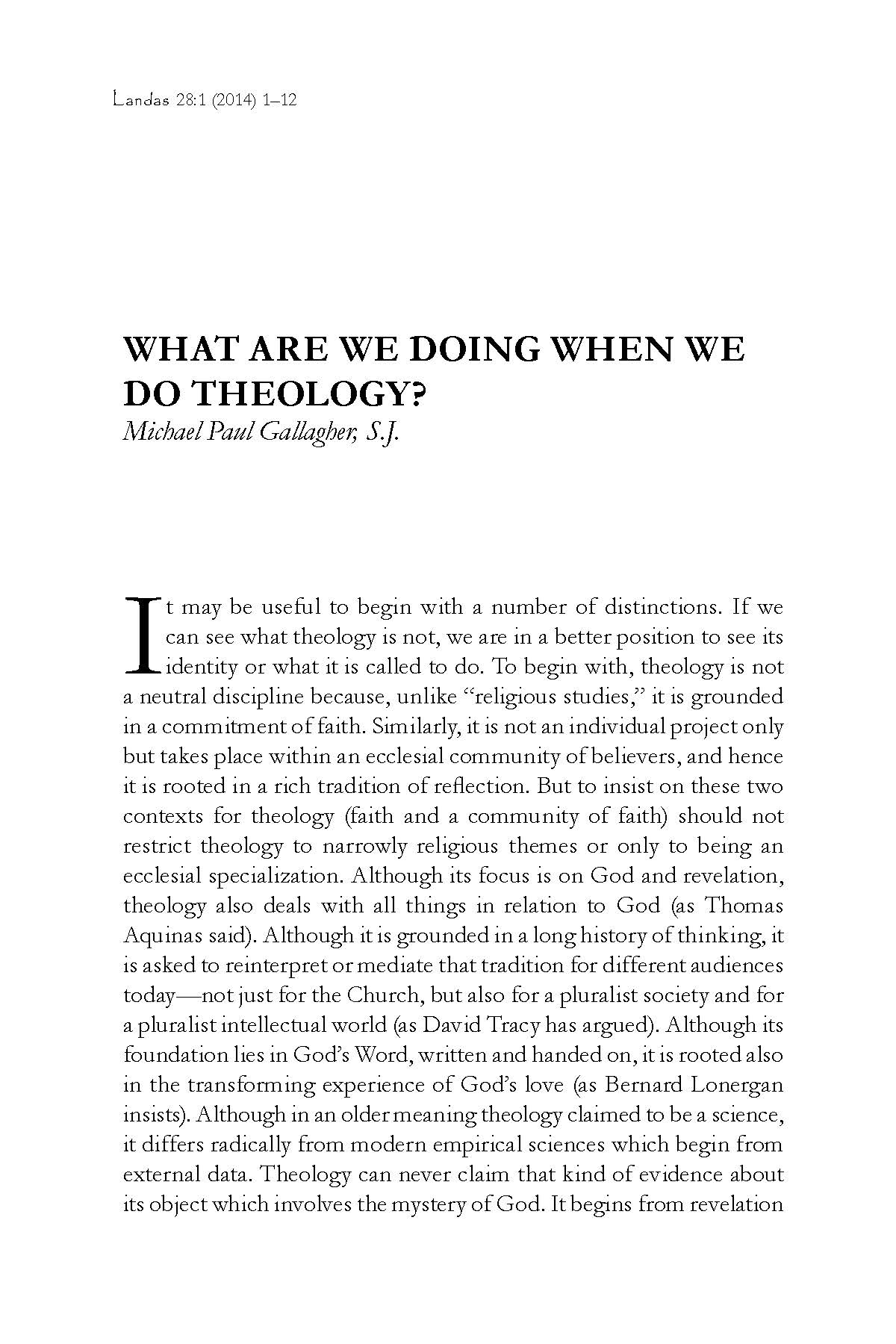
Michael Paul Gallagher, S.J. (“What Are We Doing When We Do Theology?”) explains the task of theology by grounding it on a commitment of faith and a believing community. Built upon a long history of reflection, theology nevertheless reinterprets and re-appropriates Christian tradition for the contemporary world. Gallagher notes that “theology for nearly a century now has been acutely aware of the challenge of an increasingly secular culture.” Today’s culture has profoundly shaped our interpretation of life. It is this “social imaginary” (as Charles Taylor puts it) that poses the greatest challenge to faith. It is on the level of imagination, rather than on a narrow kind of rationality, where theology needs a new language. “On this frontier the worlds of imagination—including art, poetry, music, and the new media—are more needed than a communication of theological content,” he says. “Theology, faced with these inner contexts of forgotten desire, needs to develop a ministry of disposition and to create languages of attraction and of invitation.” He also explains a variety of theologies based on changing contexts of human experience: biblical, anthropological, synthetic (inculturated), practical, transcendental, and counter-cultural. But context alone is not enough. – from the Editor’s Preface
