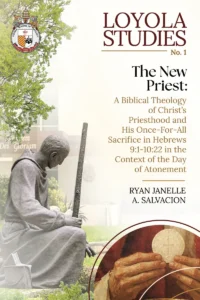
The New Priest
A Biblical Theology of Christ's Priesthood and His Once-For-All Sacrifice in Hebrews 9:1-10:22 in the Context of the Day of Atonement
This dissertation is a study that explicates the novelty of Christ’s priesthood and the meaning of His once-for-all sacrifice as contained in Heb 9:1-10:22 by interpreting the said pericope in the context of the Day of Atonement. When Heb 9:1-10:22 is interpreted in the said context, what emerges is the figure of Christ, the eternal high priest and the perfect sacrifice, who is the fulfillment and perfection of the cultic actions of the OT high priest during the Day of Atonement. What the rituals of Yom Kippur prefigured and foreshadowed in the OT are now fulfilled in the Paschal Mystery of Jesus. Hence, this study seeks to demonstrate how the priesthood of Christ and His once-for-all sacrifice found in Heb can be amply described and understood through the context of the Day of Atonement.
The other contexts in Heb 9:1-10:22 are not being denied their importance; rather, what is being argued is that their existence in Heb is dependent on the Day of Atonement being the primary context. When subsidiary contexts are misunderstood as the primary context, the reader or interpreter fails to fully understand the depth, the breadth, and the height of the Auct Heb’s theological arguments.
This study utilizes what Joseph Ratzinger/Benedict XVI calls the Method C exegesis leading towards a biblical theology of Christ’s new priesthood and His once-for-all sacrifice. Method C exegesis is the kind of interpretation of the sacred text that employs both the historical-critical exegesis of the 20th century and the traditional patristic-medieval exegesis.